Showing posts with label Parks. Show all posts

Thursday, July 17, 2008

Bringing you up to speed on Your Windy City Guide

Loyal readers will note the absence of posting by your guide for Three Whole Weeks - an unforgivable eternity in the blog posting world.  We hope you can forgive us our transgression and hope to retain your loyal readership.

The reasons have been threefold:

1.  I have not had an original thought in my head for a solid two weeks out of the last three.  The heat of the Summer must have gotten to me.  Perhaps too strong a desire to go sailing rather than think about anything real estate related. 

2.  On a positive note, we have been crazy busy.  Listing like crazy.  Wrote some contracts.  Listed some more developments.  Not the thing to do in the lazy dog-days of summer.  On top of that, our Trusty Management Expert - Steve West - also got busy.  He took over the management of a 100 unit complex in Old Town which led to a 50 unit mid-rise in Old Town, and a couple more projects coming on line in the next few weeks.  Poor Steve, work is getting in the way of his summertime fun, too.

He'll have some excellent stories to tell from the Property Management side of the business soon, though. 

3.  I have contracted with a technologically superior web-guru to overhaul the www.darrowwest.com website AND this humble blog.  I thought the project would be completed by now, but each day brings a few new wrinkles to the plan.  Before another day went by, I thought I had better get back on the bandwagon before my dearest friends forgot I was here.  Or worse - started removing links.

Boys n girls club statue park 003 

But this week while driving home from my latest listing at 3753 West Dickens (single family home for $359,900) I drove past this odd sight on Palmer out by Kedzie.  How fun is this?!

Boys n girls club statue park 001

Such a weird thing to see inside what appears to be quite an ordinary kiddie playground next door to a school.  It turns out to be the BARNET HODES Sculpture Garden. 

The centerpiece of the Logan Square Boys and Girls Club’s Barnet Hodes Sculpture Garden, this sculptural bench and fountain project holds the distinction of being the city’s first freestanding, community-built artwork-- a feat that involved the use of reinforced concrete, landscape design, and mechanical and electrical engineering. The undulating seats evoke the shapes of reclining figures: the glass mosaics in the fountain basin recall Taino designs and symbols. The form of the work was inspired by Pedro Silva’s Grant’s Tomb Mosaics (1972-1974) and Antonio Gaudi’s Güell Park ceramic-fragment-encrusted benches (1900-1914), as well as by the work of David Harding in Glenrothes, Scotland, who introduce the Chicago Mural Group to concrete as a community art medium in the 1970s.

Boys n girls club statue park 002

Hey, I'll take any inspiration that comes my way these days.  Here's hoping you find me traveling off the beaten path more often in the coming days.

Thursday, April 10, 2008

Can you "play" at a Chicago "park?"

From today's Crain's Chicago Business

A few days ago, a group of 30-something Loop office workers decided to let off a little post-5 p.m. steam. Being a healthy lot, they headed not to a bar, but to the 3-acre public park plopped amid the huge Lakeshore East residential and office complex on East Randolph Street for a pickup soccer game.

A few minutes later, the cops arrived—and busted one and all for violating an ancient and unknown city law that restricts sporting activities to sites specifically designated for sport. As reported by WFLD-TV/Channel 32, the coppers had been summoned by an adjacent condo building’s management, which says it just was trying to protect the wet turf but clearly considers the “public” park to be mostly private.

This begs the question:  Can you "play" in the "park?"

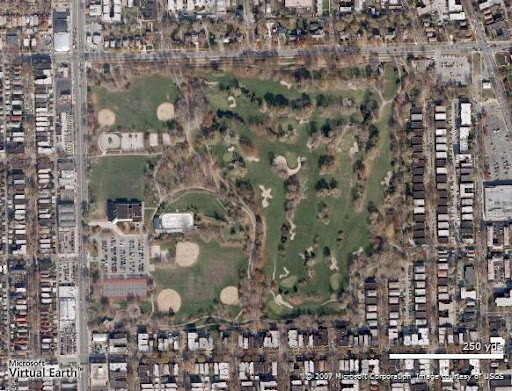
In our neighborhood, there is a bit of a struggle between parents and dog owners over whether pets should be allowed inside the newly constructed Chi Che Wang Park on West Wolfram in West Lakeview.

ChiCheWangPark

Under a little known statute in Chicago, dogs are prohibited from any parks that do not have paved walk ways through them.  Chi Che Wang Park is three-acres of lawn with nary a path, toy, object, or impediment inside its boundaries.  It's filled with families and children playing soccer, football, baseball, softball and Frisbee.   On weekends, some organized Soccer Clubs have been setting up full soccer games.  Nets, goals, uniforms, spiked shoes - the whole shebang.

And if a dog sets a toe-step inside, a neighbor usually calls the police.

Hmmm.  I wonder if a vengeful - oops - I mean - observant - area dog owner were to keep his eye out for one of these "sporting" events being held in this "non sporting" venue - could he call the police?  Or will he just get the brush off?

Thursday, March 27, 2008

Warren Park in Rogers Park

Warren Park in West Ridge/West Rogers Park

With nearly 90 acres of parkland, Warren Park is the North Region’s largest park featuring a number of special attractions for every season of the year. In April, a state-of-the-art skate park and six station baseball batting cages open to the public. The 80-by-80 foot skate park, situated to the north of the fieldhouse, contains the same equipment used by pros, including quarter pipes, pyramid combinations, street spines, launches, grind rails and fun boxes. Admission fee is $2 and is intended for skateboarders and in-line skaters only. Step up to the plate and test your batting skills at the batting cages. At the nine-station cage, choose from a variety of speeds that range from 40 to 70 mph and select either baseball or softball (12-inch) styles of play. The batting cages cost $1 for 15 pitches. Weathering permitting, the cages are open April - September. The hours of operation are Monday, Closed; Tuesday - Friday, 4 - 8 pm; and Saturday and Sunday, 11 am - 5pm. Bring your own bat.

Fitness enthusiasts can hop onto a paved path that winds throughout the park for walking, jogging or biking. Golf-lovers head to the Robert A. Black nine-hole golf course and golf putting practice area located on the northeast end of the park. Warren also boasts a racquetball court open for play on weekdays, 10 am - 7 pm for $6 per person.

In the winter months, Warren Park boasts an outdoor ice rink for skating, as well as a sled hill for all ages. This winter, the ice rink will operate (weather permitting) until March 16, 2008.

Warren Park’s programming ranges from aerobics to unique West African drum classes. For youth and teens, the park has strong after-school program (Park Kids), baseball, basketball and soccer programs. The site is also home to the North Region’s administrative offices.

History

Warren Park was created in the 1970s, born of both conflict and cooperation. The controversy began in 1965 when real estate developers purchased the former Edgewater Golf Club. Shortly thereafter, a coalition of community groups started a campaign to save the land as open space. Despite the strong community objection, however, the site was re-zoned to allow development of high-rise apartments and a large shopping center.

The State of Illinois forcefully intervened in 1970, acquiring a portion of the property to create the first-ever state park within the boundaries of Chicago. Plans to develop the remaining acreage continued, and community opposition stayed strong. In 1972, the Chicago Park District determined to purchase this land. The state transferred its property to the park district in 1975. By that time, the park had been named in honor of Laurence C. Warren (---), an attorney and leading community activist who helped save the open space as parkland. In 1980, Warren Park's nine-hole golf course was officially dedicated in honor of Robert A. Black (---), Chief Engineer to the Chicago Park District for more than thirty years.

Monday, March 24, 2008

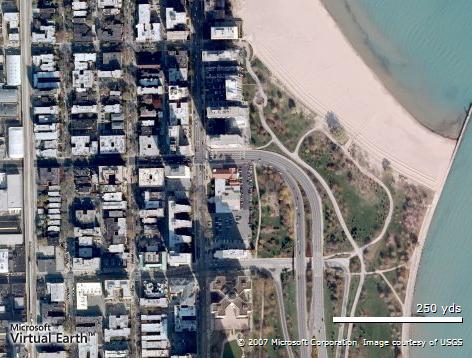
Edgewater Residents still leery of lakefront path

Lake Shore Drive at Hollywood, Chicago

There are a number of cool things about the map above.  And before I get to the point of the article that I set out to write about, I really must give a rave review to a couple of products that I discovered over the weekend.

1. This blog post (and the one on Lincoln Park) were written in Windows Live Writer.  This desktop publishing tool seems to blend the best of a desktop application with the easy-access of an online writing tool like Google Documents.  The interface is elegant and graceful, offers tons of tools, and publishes to almost any online host effortlessly.  Windows Live Writer went out and fetched all the settings from my Blogger account and seamlessly writes my posts in the same style and formatting as my blog.  I'm amazed.

2. Windows Live Writer allows me to insert photos with gorgeous effects, tables, video from YouTube and other sources as well as the amazing Windows Live Map you see above.  Check it out closely:  it's draggable; it's clickable; it's totally interactive.  It's not just a simple screen capture from Windows Live or Google Earth.

Alright, back to the topic at hand:

The Friends of the Park recently tried to revive the discussion with Edgewater residents about what they thought of extending the lakefront path north of Hollywood Avenue in front of the lakefront high rises that are east of Sheridan Road from Hollywood up to Loyola University.

Extending Lincoln Park north of Hollywood is not a new idea.  About three-dozen high rises between Hollywood and Loyola are built right up against the lake.  Past proposals including a shoreline protection study in 1987 have called for expanding the shore east of these private buildings.  Six years ago, Mayor Daley called for lakefront paths to be stretched north to run all the way to Evanston (Chicago's closest suburb to the north.) 

None of the proposals have ever materialized.  Residents in the fancy high rises and a few from Rogers Park (the most northern neighborhood in Chicago) opposed efforts expanding the shore.  They fought attempts to build marinas and helped pass an advisory referendum opposing an extension of North Lake Shore Drive.

But with the Centennial Anniversary of Daniel Burnham's 1909 plan approaching, Friends of the Parks set out to re-visit ways to complete public access to the City's lakefront.  Four of the city's 30 miles of shoreline remain in private hands despite Burnham's vision of a public lakeshore stretching from Indiana to Winnetka (north of Evanston.)  The group soon found that the idea remains a hard sell.

Mind you, folks living WEST of Sheridan Road seemed excited about greater access to the lake.  The president of an association representing 33 buildings along Sheridan Road supported the idea of extending the lakefront path.

But several residents in high rises EAST of Sheridan Road say they weren't consulted.  They say they were not aware that Friends of the Parks was developing ideas for a park extension until it was too lake to offer input.

They also worry about privacy and security issues should public park space be constructed right behind their buildings.  They fear clogged traffic on Sheridan Road will become even worse.

Your guide hopes that continued efforts in the coming years results in the opening of the lakefront along this stretch of Sheridan Road.  One of the complaints of Sheridan Road residents was that the sidewalk alongside Sheridan Road is already congested with pedestrians and bicyclists.  Residents have forced local police to vigilantly patrol this stretch for bike riders on the sidewalks.  But Sheridan Road is so narrow that any bicyclist brave enough to ride in traffic along Sheridan Road surely takes their life into their hands as they dodge turning cars, CTA buses and delivery trucks.  In reality, the creation of the lakefront path would alleviate much of the sidewalk congestion in this area and make both areas safer for pedestrians and bicyclists.

Saturday, March 22, 2008

Tour: Lincoln Park Zoo in Winter (really Spring)

I helped out some clients today with renting out their investment condo, and since they brought the whole family in from the suburbs, and the condo is located near the Lincoln Park Zoo, I couldn't resist dragging the family over to the new Children's Park inside the Zoo.

LP Zoo March 009

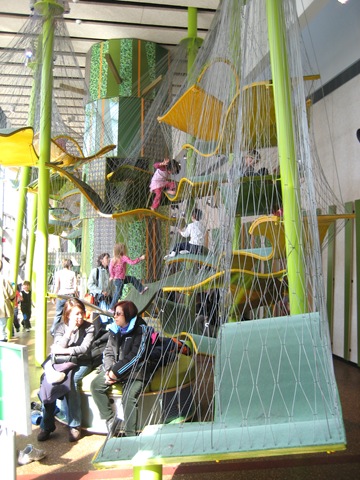
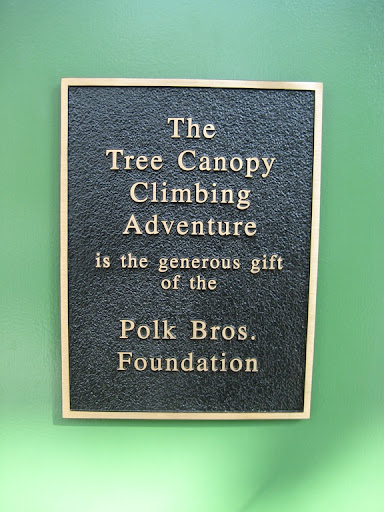
The new Tree Canopy Climbing Adventure can be found just south of the Sea Lion pool inside the main gate to the zoo.  This thing is amazing.  Where were play parks like this when I was a kid? 

LP Zoo March 008

The multi-level environment is filled with exhibits featuring animals found in jungle canopy trees. 

LP Zoo March 006

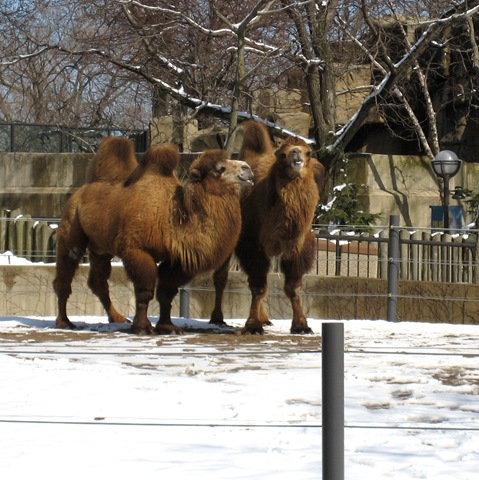
Outside, other animals seemed to be making do in the early Spring snow. 

LP Zoo March 001

Yeah, this guy doesn't look like he's anticipating the warmer weather any time soon.

LP Zoo March 004

These two look like they took care of the Easter Bunny.

LP Zoo March 014

Thursday, March 13, 2008

Diversions - things to to this weekend in Chicago


Some of my favorite suggestions for things to do in and around Chicago this weekend. A bit offbeat...

TRAN - The Atari Musical

Thursdays, Fridays, and Saturdays : 8 p.m. (ends March 22) Price $15

The Spot in Uptown, 4437 N. Broadway

A gender-bending, multimedia musical satire of the 1982 Disney film "Tron" (one of the first movies to extensively use computer generated images) features '80s music, video game intrigue and characters who attempt to discover where the sexual freedom of the '70s went. Yeah, I know, this only really works for children of the '80's.

The Purr-fect martini contest at the Kitt Katt Club

3700 N. Halsted St.

Think you mix the best 'tini? Prove it by sending us your own "purrfect" recipe now for the chance to win a trip for two to Las Vegas, and see your martini grace Kit Kat's menu for one year.

53rd Annual Chicago St. Patrick's Day Parade

Saturday at Noon, starting at Balbo (7th) and Columbus (east of Michigan Ave.)

Not as rowdy as last week's South Side Irish Parade, the St. Pat's celebration kicks off with the traditional dyeing of the Chicago River at its junction with Michigan Avenue (10:45 a.m.) and continues with this hugely popular parade. See floats, Irish step dancers, bands, clowns, Clydesdale horses and more.

Monday, December 3, 2007

Hidden Chicago - The Gold Coast from Olive Park


This spectacular photo of Chicago's North Lake Shore Drive was not taken from a boat. Few Chicagoans and even fewer visitors realize that you can walk out on a promontory that affords this amazing view. The location is called Olive Park and it's located next to the Jardine Water Filtration Plant. The way you get here is to start at Navy Pier and head west on Grand Avenue - but only a few hundred feet. Before passing the back of Lake Point Tower, take a stroll through the small park just north of Grand. As you head towards the water, you'll see a gated archway that leads to a long narrow parkway that extends out into the lake. Walk a hundred yards or so to a scenic overlook and start taking pictures. Anyone who sees your photos will be amazed at the vantage point you've discovered.

Saturday, October 20, 2007

Sunny and warm Saturday in October

We've posted before lamenting Chicago's un-seasonal weather. Usually to complain. But we're working on our third Indian Summer here in Chicago this weekend with sunny skies and temps in the mid-70's. Check out Chicagoans enjoying these last days of late-summer.


Julius Meinl at Southport and Addison


Southport Lanes at Southport and Roscoe


Wiggly Field - one of Chicago's most famous dog-friendly parks.

Monday, July 16, 2007

TOUR: Chicago's Lakefront Path and Parks

It was one of Chicago's founders, Daniel Burnham's idea that Chicago's Lakefront should be free and clear for the enjoyment of its residents. Burnham's plan dates back to 1909 after the Great Chicago Fire and allowed Chicago to be re-built in an orderly and thoughtful fashion. One of the hallmarks of the new Plan for Chicago was the creation of the Parks and Lakefront Boulevard to act as Chicago's front yard for everyone to enjoy.


Today, the lakefront path stretches from the South Shore through Downtown and up through Edgewater. This tour highlights the lakefront from Downtown in Grant Park, northward for eight miles, through seven eclectic Chicago neighborhoods, until it ends near Chicago's border with its closest suburb - Evanston.


In the heart of Downtown along the lakefront is Grant Park. In the early 1900's, captains of industry such as Marshall Field and Montgomery Ward built skyscrapers over Michigan Avenue looking towards the lake. In the center of Grant Park is one of Chicago's most recognized landmarks - Buckingham Fountain. A gift from Kate Buckingham in memory of her brother, Clarence Buckingham, and modeled after Latona Fountain at Versailles.


To the north, and seamlessly across the street is the newly finished Millennium Park. Less formal and more interactive, Millennium Park contains sculpture, water fountains and gardens where you're invited to touch and interact with your surroundings. The centerpiece is closest to Michigan Avenue - the sculpture called "Cloud Gate" and affectionately referred to by Chicagoans as "The Bean." As you touch the sensuously polished stainless steel facade, ask yourself if you think it's worth the $25-million paid for it.


Leaving Millennium Park the path turns east to give room for the "New East Side" and its glimmering new high-rises.


Next, you'll join automobiles and pedestrians in a congested stretch to cross the Chicago River on a double-decker draw-bridge. Immediately after the bridge is Navy Pier. Chicago's most popular tourist attraction with over 6-million visitors each year, the pier serves up food-on-a-stick, offers carousel and ferris wheel rides as well as hosting glitzy galas in its renowned ballroom and on the many cruise ships docked alongside.


A little known insider's spot can be found just north of Navy Pier. Rather than following the path directly alongside Lake Shore Drive, follow the sidewalk out towards the lake past the Water Treatment Plant. The small "Olive Park" features vistas from a few hundred feet out into the lake looking back at Chicago's Gold Coast and Streeterville neighborhoods. Usually only boaters have such a magnificent view of the skyline, and photos of the city from here will be the envy of all who see them.


The landscape is minimal as you continue as the path is only a few yards wide wedged in between the water and the roadway. Notable architecture abounds, however. Keep your eye out for the soon-to-be demolished Lakeshore Athletic Club at Chicago and Lake Shore - the perfect Beaux-Arts foil for Ludwig Mies van der Rohe's exquisitely skeletal 860-880 Lake Shore Drive next door.


As you round the corner that takes you a little west, note that this stretch of East Lake Shore Drive is the toniest address in Chicago with 3,000 square foot apartments selling for multi-millions. Oak Street Beach is literally an oasis where you can relax on the sand and find food and water at the lakefront cafe.


In the next stretch of lakefront path, the most notable lakefront architecture is the absence of Potter Palmer's mansion on the site of the hideously ugly (but perfectly landscaped) twin orange apartment towers at 1350 and 1360 North Lake Shore Drive. Potter Palmer was Chicago's most famous Hotel Baron and the builder of the Palmer House Hilton on Wabash.


As you travel through a small grove of trees and past a pavillion where men and boys play chess, you stumble upon North Avenue Beach and the beginning of Lincoln Park. Anchoring North Avenue Beach is the boat house. Modeled after a ship, the building contains lockers, showers, a restaurant and cafe's. Stretching northward is a mile of sandy beach filled with volleyball courts and sun-bathers.


Keep your eye out for a bridge over Lake Shore Drive if you wish to take a diversion into the park. Meandering through the park rather than along the lakefront offers less eye-candy, but more activities. First you'll come across the Lincoln Park Zoo. One of the nation's oldest zoos housing 1200 animals representing 230 species. Even better - admission is free! Next door to the zoo is the Lincoln Park Conservatory. Lincoln Park Conservatory was designed by a well known architect of the Victorian era, Joespeh L. Silsbee. With its four display houses: the Palm House, Fern Room, Orchid House and Show House - home to the annual flower shows - the Conservatory continues to provide a haven in the city. Around the corner from the Conservatory is the Notebaert Nature Museum - a natural oasis right inside the city. One highlight is a greenhouse filled with butterflies, including many not found in our region.


Travelling north from Fullerton Avenue, the path takes you past tennis courts, atletic courses and a variety of other paths leading to various corners of the park. Stay on the path for a fast ride to Belmont, or turn off at Diversey Harbor for a ride past the boats and a golf practice range. Stay in the park and you'll come across kids play areas and some wide open fields where weekend touch-football is popular. Both paths converge near Belmont Harbor where a small beach is crammed in alongside all the boats.


Near Addison is a popular meeting spot for running and biking clubs - the Totem Pole. Amenities abound as you pass north from the Totem Pole. Ten tennis courts, a large parking lot and two baseball diamonds draw nearby residents to the park in droves. A nine-hole golf course is laid out towards Montrose and paths diverge - one along the water and another along Lake Shore Drive. Both lead to Montrose Harbor.


From Montrose to Foster, the park widens to accommodate many recreational amenities. This one-mile stretch contains baseball fields, basketball courts, a dog beach, the boat harbor, a nature preserve, kid playgrounds, a skateboard park, soccer fields, tennis courts and volleyball courts. An access road meanders between Montrose, Wilson and Foster with plenty of parking. The lakefront path branches off to take you to all the different corners of the park, but eventually all meet up on the north end funnelling you towards Hollywood Beach - the last bit of public lakefront in Chicago.


View all the photos from our Lakefront Tour.

Saturday, April 21, 2007

Overlooking Chi Che Wang Park from the Regal Lofts Penthouse


A photo of Chi Che Wang Park - located at Hermitage and Wolfram - taken from the Penthouse at the Regal Lofts, 1735 W. Diversey. Just because I could. Of note today, the remaining ring around the park that was missing sod was just sodded. If you look closely you can see the workmen just scurrying out of the park to the right.


Quite a different scene than Chicago on April 11 - just 10 days ago! (Scroll Down)

Wednesday, March 7, 2007

Outdoor Art in Downtown Chicago

Your guides play host to a wide variety of international visitors as we are members of an international travel club called The Hospitality Club as well as hosting relocating job transferees in our capacity as Realtors.


One fantastic aspect of Chicago is its ever-growing collection of world-renowned outdoor art. I think this guide is a bit limited but if you were to try to view all the art described in this article it would surely take longer than a full day. Readers that notice any omissions are welcome to post a comment.


You can't go wrong by simply starting out with a walk through Millennium Park. You'll first be drawn to the large bean shaped "Cloud Gate" sitting on top of the concessions along Michigan Avenue. By combining distorted images of spectators and their surroundings, the piece encourages us "to consider how we as individuals face a culture, with all the superficiality, speed and visual reflection and really make it ours." says Jonathan Fineberg, a professor of art history at the University of Illinois. Most people I saw were simply making funny faces and silly poses.


Continue south through the park and visit the other insanely popular pop-art piece: The Crown Fountain - aka "Sptting Faces." This is interactive art at its best combining a variety of traits that make patrons completely comfortable interacting with the setting. It's a fountain that pays tribute to city residents who are encouraged to step into the shallow water and falling sprays while looking at themselves larger-than-life.


Leaving Millennium Park and continuing south, you seemlessly cross into Grant Park. More formal than Millennium Park, pathways follow the straight and narrow and gardens are more like you'd find in European Palace grounds. All paths lead to Buckingham Fountain in the center of the park, a memorial surrounded by fencing to keep people out. How proper.


On the south end of Grant Park is the newest installation - Polish Artist Magdelena Abakanowics' "Angora." Walking through the installation of 106 headless figures provokes a flood of associations. Among them: war, nature, democracy and isolation. Their juxtaposition helps viewers reflect on the connection among them.


Walk out along the path and roadway towards the Adler Planetarium and you'll find Denise Milan and Ary Perez' "Americas." The multi-colored granite blocks, which can be rearranged in a variety of designs, encourages a sense of community by drawing those who sit in the installation into a circle.


You'll backtrack a bit, but it's worth the trip to head into the downtown area to get a look at some of Chicago's older sculpture located inside the urban canyonscape. At the State of Illinois Building - Clark Street at Randolph - a series of white concrete morphing shapes is titled "Monument with Standing Beast." Kids love it. A former city deputy budget director said "They should have a voter referrendum on whether to take this thing and throw it in the bottom of Lake Michigan. It's the ugliest thing I've ever seen in my life."


In Daley Plaza - at Washington and Dearborn - you'll find the untitled sculpture by Pablo Picasso. It's a landmark and a masterpiece that residents have come to associate with the City. Is it a giraffe? A lion? A monkey?


Two blocks south on Dearborn in Federal Center Plaza, you'll find Alexander Calder's "Flamingo." Paul Gapp, Chicago Trib's architecture critic said "The kindest thing that can be said about 'Flamingo' is that it is vandal-proof and appears to frighten away pigeons." Nice.


On West Madison at Clinton, in front of the Harold Washington Social Security Center, is Claes Oldenburg's "Batcolumn." This 10 story baseball bat is oddly out of place both in relation to its location in the financial district and it's placement outside the Social Security Administration. Gotta use those Federal Matching grants somehow. I wonder who the artist is related to in City Hall?


This last suggestion is hard to walk to, but with a morbid twist. Between the Ohio and Ontario feeder ramps onto the Kennedy Expressway at Orleans Street is "The Flame of the Millennium" sculpture. You really only get a quick glimpse of this sculpture as you whiz by at 50 mph on your way in or out of River North. As a side-note, horrified Friday-morning commuters watched a man apparently douse himself with gasoline and lit himself on fire along the Kennedy near the 25-foot-tall sculpture in late 2006.